
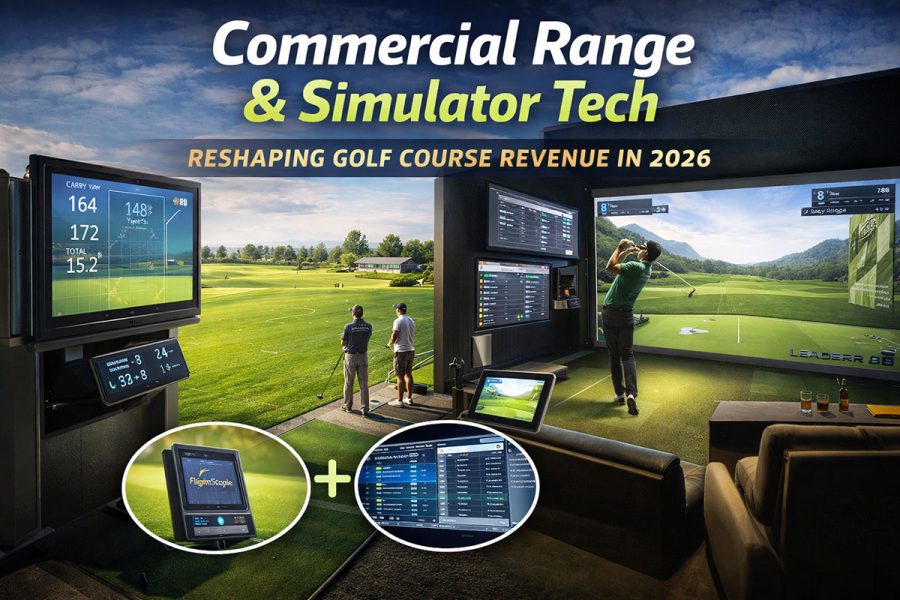
For many golf courses, the next big growth opportunity is not only on the course. It is on the range, in teaching bays, and inside simulator spaces. Commercial range and simulator tech is moving quickly in 2026, and the latest launches and show-floor emphasis from the PGA Show in Orlando make one thing clear: golf facilities are no longer looking at launch monitors and simulators as “nice extras.” They are becoming real business tools for instruction, player development, leagues, events, and off-season revenue. The 2026 PGA Show itself positioned technology as a major part of the event, with more than 1,000 brands represented and a reworked on-floor testing area built around equipment, simulators, and hands-on tech experiences.
One of the clearest signs of this shift was the PGA Show’s new Range Performance Center. Show organizers said the space included two hitting bays using Inrange technology and programming built around coaching, player development, golf range operations, and facility optimization. That is important because it shows simulator and range technology is being discussed not just as player entertainment, but as an operations and business-growth strategy for facilities.
Why commercial range and simulator tech matters more now
Golf facilities are under pressure to do more than sell buckets of balls. They need to create a better practice experience, attract different types of players, and find more ways to generate revenue per visit. That is why commercial range and simulator tech is becoming so valuable. The newest systems are designed to combine data, entertainment, instruction, and operations into one connected platform. Instead of a range being just a warm-up area, it can become a destination for practice, game improvement, lessons, leagues, contests, and social play. That broader direction is showing up in both the U.S. and Europe. Hanse Golf’s 2026 event impressions reported 16,560 visitors and 190 exhibitors, while Rheingolf promoted more than 10,000 expected visitors for its February 20–22, 2026 event in Düsseldorf, showing strong international demand for new golf products, experiences, and business ideas.
Permanent-bay launch monitor systems are becoming more practical
One of the more notable 2026 examples is FlightScope Range Gen2, which FlightScope introduced around PGA Show week as a system built specifically for outdoor driving ranges, teaching facilities, indoor commercial bay installations, and permanent indoor setups. FlightScope positions it as a way to move beyond entertainment-only range systems and into “pro-grade” ball and club data, while still giving facilities simulation features through included E6 Connect content. Its product page also highlights open integration with gaming, POS, and dispensing systems, which is exactly the kind of flexibility courses need when they are building a commercial range environment instead of a standalone tech demo.
That matters because the commercial side of range technology is no longer just about measuring launch angle and ball speed. It is about building a bay that can serve multiple purposes. A facility may use the same bay for instruction in the morning, member practice in the afternoon, and simulator-based events at night. FlightScope says Range Gen2 includes an E6 Connect package for iOS and PC, with eight included courses and no extra annual subscription fee for that package. That type of bundled content makes it easier for a golf course or indoor facility to turn a practice bay into a playable virtual golf experience without needing a completely separate system.
The real value is in software, integration, and repeat engagement
Hardware gets attention, but software is what often determines whether a commercial range actually makes money. That is where platforms like Inrange stand out. Inrange says its radar-based technology is designed for commercial ranges, golf entertainment venues, resorts, country clubs, and indoor spaces. The company emphasizes full-flight tracking, low shot latency, no lighting requirement, 3D laser mapping of the outfield, and open APIs that can connect with booking platforms, POS systems, ball dispensers, in-bay auto tees, launch monitors, lighted targets, and CRM tools. For operators, that is a big deal. It means range tech is becoming part of the full customer journey, not just a screen at the bay.
Inrange also makes a strong business case for why facilities are paying attention. On its golf software page, the company says partners have seen an average revenue increase of more than 80%, a minimum expected ball-volume increase of 50%, and as much as eight hours of play per bay per day at top-performing ranges. Those are company-reported figures, not neutral industry averages, but they still show how range tech vendors are now selling outcomes instead of just equipment. The same page highlights practice modes, pressure-based target games, global course play, leaderboards, and the ability to run league nights, long-drive events, and competitions. In other words, commercial range and simulator tech is increasingly about keeping players coming back.
Simulator software is getting deeper and more commercial-friendly
Another important 2026 trend is content depth. Facilities need software that can do more than show a driving range screen. E6 by TruGolf now promotes 15,000 courses, multiple play modes, club fitting tools, bag mapping, skills challenges, and web-based clubhouse leaderboards. TruGolf’s 2025-26 product materials also show a strong push into commercial solutions, with categories for commercial simulators, indoor driving range products, and an E6 commercial suite. That matters for golf courses because the more content a platform offers, the easier it is to keep bays busy with lessons, league nights, member events, winter play, and private bookings.
TruGolf also notes that E6 now includes modes like Stroke, Scramble, Best Ball, Match Play, Stableford, and Closest to the Pin, along with on-course practice, club fitting, bag mapping, and 46 skills challenges. For a golf course operator, those features matter because they support different audiences. Serious golfers want data and practice tools. Casual players want game formats. Coaches want fitting and improvement tools. Operators want events and leaderboards. The best commercial range and simulator tech in 2026 is the tech that serves all of them at once.
What golf courses should be thinking about right now
If a golf course is considering commercial range and simulator tech, the first question should not be, “Which screen looks coolest?” The better question is, “What problem are we trying to solve?” Some facilities want to increase lesson revenue. Some want more range usage. Some want an indoor offering for colder months. Some want a better member amenity. Some want a new event and social product. The right system depends on the goal, but the 2026 direction is clear: buyers are leaning toward platforms that combine accurate tracking, flexible bay use, software depth, and strong integration with the rest of the facility.
For many local golf courses, the smartest move may be to start small. One or two well-planned commercial bays can test demand before a larger rollout. A course can use them for teaching, fittings, memberships, simulator leagues, and shoulder-season events. If those bays are tied into booking, POS, and event programming, they can become much more than a practice add-on. They can become a revenue center. That is why commercial range and simulator tech deserves serious attention in 2026. The products are getting better, the software is getting deeper, and the business model is becoming easier to understand.
Final thoughts
Commercial range and simulator tech is no longer just for giant entertainment venues or luxury indoor clubs. Based on what stood out at the 2026 PGA Show and from the product direction of companies like FlightScope, Inrange, and TruGolf, this category is becoming more practical, more integrated, and more revenue-focused for everyday golf facilities. Courses that want to create stronger practice experiences, attract more off-course traffic, and build more year-round engagement should be paying close attention now.