
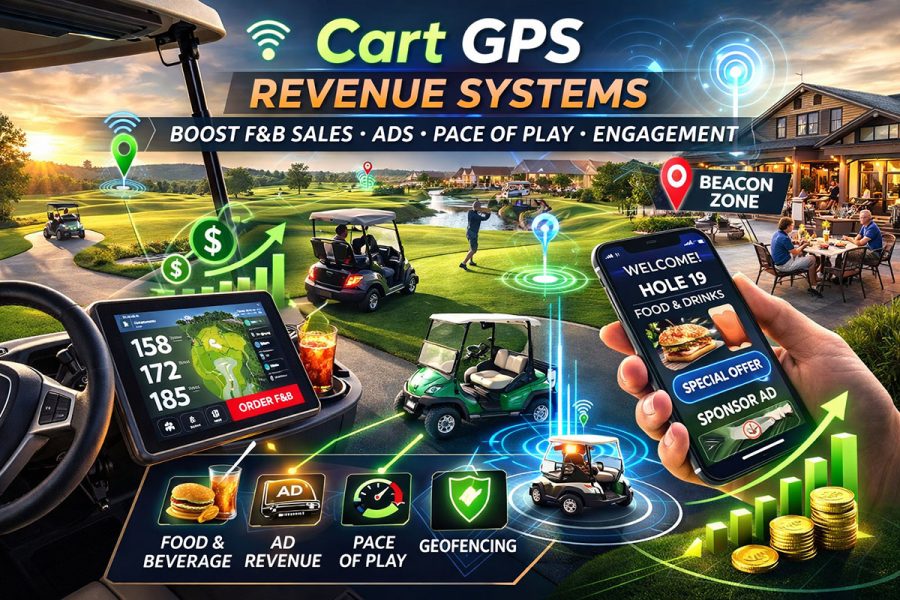
Golf course operators have spent years thinking of cart GPS as a convenience feature. In 2026, that mindset is changing. Based on the product direction highlighted around the PGA Show and on current vendor platforms, cart GPS revenue systems are becoming a much bigger business tool. They now combine yardage, messaging, food and beverage ordering, advertising, pace-of-play control, fleet tracking, geofencing, and golfer engagement into one connected platform. The broader PGA Show itself leaned heavily into expanded technology experiences in 2026, reinforcing how much the golf industry is investing in connected systems and operational technology.
That matters because the golf cart is one of the few places where a course has a golfer’s attention for four or more hours. Companies like Club Car, Yamaha, PACE Technology, Reach Golfers, and FAIRWAYiQ are all pushing a similar idea: the cart screen is no longer just a digital scorecard or distance tool. It is a live communication channel between the course and the player, and that opens the door to new revenue and better operations at the same time.
Why cart GPS revenue systems matter more now
The newest cart GPS revenue systems are built around more than golf data. Club Car Connect highlights pace-of-play reporting, two-way messaging, geofencing, food and beverage add-ons, battery monitoring, drive history, and tournament integrations. PACE Technology markets food and beverage ordering, ad displays, tee sheet integrations, weather integrations, dynamic speed control, and centimeter-level pin positioning with ONYX and TruPin. Yamaha’s YamaTrack promotes on-screen ordering, on-screen advertising, 3D hole flyovers, and a companion player app. When multiple major vendors start clustering around the same features, that usually signals where the category is heading.
For golf courses, that means cart GPS revenue systems are now part guest experience platform, part operations dashboard, and part media inventory. A course can use the same platform to improve the golfer’s round, guide cart behavior, send safety alerts, support tournament play, promote clubhouse specials, and create sponsor placements that did not exist before. FAIRWAYiQ, for example, positions its cart screen around hole flyovers, two-way messaging, pace-of-play management, turf protection, food and beverage ordering, Golf Genius integration, and an advertising network.
Where the revenue comes from
The most obvious revenue stream is food and beverage. Yamaha says YamaTrack can increase revenue with on-screen ordering anywhere on the course and can be customized with a club logo and menu. PACE says golfers can place orders from anywhere on the course without waiting at the clubhouse. Club Car says golfers can message the beverage cart directly through the touchscreen, which can increase food and beverage profit. Reach Golfers goes even further in its own 2026 materials, saying courses using strategic cart-based ordering are seeing a 10–20% increase in food and beverage revenue. Those are vendor-reported claims, but they show how aggressively the category is being positioned around direct sales lift.
The second major revenue stream is advertising. Yamaha explicitly promotes customizable on-screen advertising and says courses can increase revenue by sharing advertising opportunities. PACE says courses can reach customers in the cart with multimedia ads to support local advertisers, drive site initiatives, and bring in more revenue. Reach Golfers says a single advertiser partnership can generate at least $500 per month per advertiser, again as a company claim rather than an independent industry benchmark. Still, the pattern is clear: cart GPS revenue systems are being sold as digital ad platforms, not just golf tech.
There is also a pricing and capacity angle. Reach Golfers says golfer-facing benefits can justify premium cart or green fees and claims that a nominal fee increase can offset a 70-cart GPS fleet investment in year one. The same company also argues that AI-supported pace insights can help unlock additional tee times. Those are promotional claims, but they line up with the broader industry push toward using on-course data to increase throughput and capture more revenue per round.
The operational side is part of the ROI too
One reason cart GPS revenue systems are becoming easier to justify is that they do not only create revenue. They can also reduce waste, protect turf, and improve staffing efficiency. Club Car emphasizes real-time vehicle position, pace reporting, geofencing, lockdown controls, and drive history. Yamaha promotes tracking, shutdown and lockdown features, web-based operation management, and battery-condition monitoring. FAIRWAYiQ positions its platform around proactive pace-of-play management, turf protection, private-cart management, and maintenance staff monitoring.
Tagmarshal’s 2026 materials add useful scale to that conversation. The company says its golf cart GPS system tracked more than 17.5 million rounds in 2025 across more than 900 course partners, and it uses that volume of data to help facilities improve pace, retention, and tee-sheet optimization. That does not mean one platform is right for every course, but it does show that cart GPS is no longer a niche category. It is now part of mainstream golf operations.
Where Giraffix Golf’s beacon system fits in
This is where Giraffix Golf has an opportunity to think bigger than the typical cart screen.
Most cart GPS revenue systems focus on golfers once they are already in the cart. That is valuable, but it misses several important touchpoints: arrival, bag drop, practice greens, range bays, first-tee staging, halfway house areas, sponsor activations, clubhouse dining, tournament registration, and post-round upsells. Based on the Giraffix Golf beacon system plan we have already mapped out, a Bluetooth beacon layer could extend the course’s messaging and monetization beyond the cart and into the full on-property journey.
In practical terms, that means a Giraffix Golf beacon system could work alongside cart GPS instead of replacing it. The cart screen handles on-course yardage, geofencing, live ordering, and pace alerts. The beacon system adds location-triggered messaging through an iPhone and Android app, letting a course deliver timely content when a guest enters a specific zone. That could include a welcome message at arrival, a driving-range lesson offer near the practice area, a turn special near holes 8 or 9, a sponsor promotion near a featured hole, a safety notice near a weather shelter, or a dinner push when a round is wrapping up.
It also creates a smarter management structure. In the Giraffix Golf concept, the pro shop manager could control pro shop and first-tee messaging, the bar or restaurant manager could control food and beverage beacons, the course manager could oversee all zones, and Giraffix Golf could retain a top-level admin role for strategy, compliance, and support. That kind of role-based access matters because golf course messaging should not become a free-for-all. It should stay organized, brand-safe, and easy for each department to manage.
Why a hybrid system could be more valuable than cart GPS alone
A hybrid cart GPS plus beacon strategy could be especially useful for modern golf operations because not every golfer interacts with the course the same way. Some facilities have walkers. Some have private carts. Some have indoor teaching bays, practice areas, event pavilions, and restaurants that sit outside the main cart journey. FAIRWAYiQ already promotes management for private member-owned carts, and Yamaha already supports a mobile player app in addition to its in-cart tools. That suggests the broader market is moving toward multi-touchpoint systems rather than single-screen experiences.
That is where Giraffix Golf can build something more flexible and more marketable. A cart GPS system can tell golfers where they are. A beacon-supported mobile layer can tell the course when and where to communicate for revenue, retention, hospitality, and sponsorship. For clubs and public courses trying to modernize without feeling overly intrusive, that is a powerful difference.
What golf courses should do next
If a golf course is evaluating cart GPS revenue systems in 2026, the best first step is not choosing a vendor. It is defining the business goal. Do you want more food and beverage sales? Better pace of play? More sponsor inventory? Stronger tournament messaging? Better fleet control? Fewer turf issues? Once the goal is clear, it becomes much easier to compare systems and decide whether your operation needs a traditional in-cart platform, a more advanced connected fleet system, or a hybrid model that includes mobile beacon activation as well.
For many courses, the smartest long-term move may be to treat cart GPS as one piece of a larger digital ecosystem. Your website, tee sheet, sponsor packages, tournament sales, food and beverage promotions, and on-course messaging should all work together. That is exactly where Giraffix Golf can help — not only with the marketing side, but with the strategy behind how technology, sponsorship, messaging, and customer experience fit together.
Final thoughts
Cart GPS revenue systems are no longer just about distance to the pin. In 2026, they are becoming a real profit center for golf courses by combining food and beverage ordering, advertising, pace management, geofencing, messaging, and fleet intelligence into one connected platform. The vendor direction is consistent, the feature sets are getting stronger, and the opportunity for golf courses is becoming much easier to see.
For Giraffix Golf, the next opportunity is to push the idea further. A beacon-enhanced system built around role-based controls, iPhone and Android app triggers, sponsor activations, and location-based messaging could help courses monetize more of the property, not just the cart path. That is the kind of technology story golf courses can market, sell, and scale.
Suggested FAQ Section
What is a cart GPS revenue system?
A cart GPS revenue system is a golf cart technology platform that combines GPS yardage with business features like food and beverage ordering, advertising, pace-of-play monitoring, two-way messaging, fleet tracking, and geofencing.
How do cart GPS systems make money for golf courses?
They can generate more food and beverage orders, create paid ad placements, support premium cart or green fees, improve pace of play, and help courses add revenue through more efficient operations. Vendor materials from Yamaha, PACE, Club Car, and Reach Golfers all position their systems around those outcomes.
Would a beacon system replace cart GPS?
Not necessarily. A beacon system makes the most sense as a complement to cart GPS, extending messaging and offers to mobile touchpoints like arrival areas, practice zones, sponsor locations, and clubhouse spaces.