

For many golf courses, the website is supposed to be a growth tool. Instead, it becomes a monthly expense tied to a proprietary platform that limits flexibility, restricts SEO, and keeps the course dependent on someone else’s system.
That is why golf course website ownership matters more than ever.
If your course is paying recurring fees for a website, online store, booking tools, and POS-connected features that you do not truly control, you are not building a long-term asset. You are renting one. Over time, that difference becomes expensive.
At Giraffix Golf, we believe golf courses should own the digital foundation of their business. Your website should work for your pro shop, your memberships, your events, your gift cards, your content strategy, and your long-term revenue goals. Most importantly, it should belong to your course.
Why Golf Course Website Ownership Matters
When a golf course invests in a website, that investment should create value over time. However, many proprietary platforms are built around dependence. They offer convenience up front, but they often limit what the course can change, expand, optimize, or integrate later.
That creates a real problem.
A golf course website should not just display basic information. It should help your facility:
- sell merchandise online
- promote tournaments and outings
- support memberships and gift cards
- publish SEO content
- capture leads
- connect to POS and operational tools
- grow repeat customer value
When you do not control the platform, you usually do not control the full opportunity either.
That is the heart of golf course website ownership. It is about keeping your marketing, sales, and customer experience aligned with your goals instead of someone else’s software model.
How Proprietary Fees Quietly Drain Revenue
Most golf course operators do not object to paying for useful tools. The real issue is paying ongoing fees for a system that still feels restrictive.
That restriction often shows up in small ways at first. Maybe the website is hard to update. Maybe the store is limited. Maybe your content options are too rigid. Maybe your SEO settings are weak. Maybe every custom request turns into another invoice.
Then the pattern becomes obvious.
The course is paying month after month, but the platform still controls the rules.
That can affect everything from product merchandising to landing pages to integrations to content publishing. Even worse, many courses end up building years of traffic, pages, and customer habits inside an environment they do not fully own.
If the relationship changes, the cost goes up, or the service no longer fits the facility, moving becomes harder than it should be.
Golf Course Website Ownership Creates Better eCommerce and POS Flexibility
A modern golf course website should do more than hold a tee sheet and a contact page. It should support real commerce.
That includes online pro shop sales, gift cards, memberships, lesson packages, simulator bookings, event registration, and seasonal promotions. It should also be flexible enough to work alongside the POS tools your course already uses or plans to use.
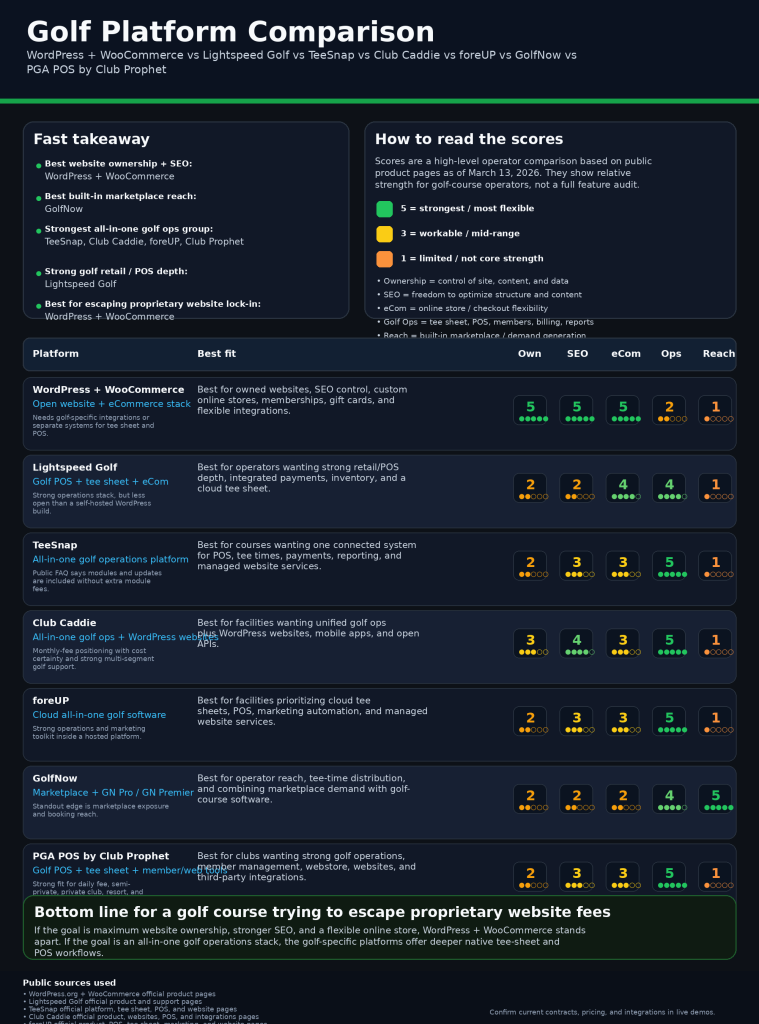
This is where a WordPress-based approach can be a major advantage.
Instead of forcing your course into a one-size-fits-all system, a flexible website can be built around the way your business actually operates. That means your store structure, your landing pages, your promotions, and your content can support the entire facility rather than just one narrow function.
For example, your course may want to:
- feature branded apparel and accessories
- sell outing packages or tournament entries
- offer online gift card purchases during the holidays
- promote membership campaigns with dedicated landing pages
- connect web forms to your CRM or email list
- organize products and promotions by season
A proprietary platform may allow some of that. A fully owned website gives you much more room to shape how it all works together.
Golf Course Website Ownership Improves SEO and Lead Generation
One of the biggest hidden costs of proprietary platforms is weak SEO flexibility.
If your course cannot easily create optimized landing pages, publish blogs, customize metadata, improve internal linking, structure product categories, or control content layout, your website becomes harder to grow organically.
That matters because search visibility is not just a branding benefit. It drives real business.
When golfers search for terms related to tee times, tournaments, memberships, private events, lessons, gift cards, dining, or golf merchandise, your website should be positioned to compete. That does not happen by accident. It happens when your site is built with content, structure, and long-term optimization in mind.
A better website helps your course:
- rank for local golf-related searches
- create service pages that target intent
- support blog content for SEO growth
- build stronger internal links between offers
- improve visibility for pro shop and event pages
- convert search traffic into inquiries and sales
With golf course website ownership, your site becomes an asset that can improve over time instead of a locked template that stays mostly the same.
What Your Course Should Control Instead of Rent
Every course is different. Still, there are a few areas nearly every operator should want to control directly.
Your website should give your course ownership over:
Content
Your pages, blogs, media, and messaging should be easy to update without depending on a vendor for every change.
Design
Your site should reflect your course brand, not the limits of a template.
SEO
Your metadata, headers, page structure, internal links, and content strategy should support long-term growth.
eCommerce
Your online store should be able to support real promotions, categories, upsells, and seasonal campaigns.
Integrations
Your website should be able to connect with the POS, booking, email, form, and tracking tools that matter to your course.
Customer experience
From mobile browsing to checkout to lead capture, the site should be built around how guests actually use it.
When a course owns these fundamentals, it has more control over revenue and less dependence on recurring platform restrictions.
Signs Your Current Platform Is Holding Your Course Back
Some golf courses already know their current setup is limiting them. Others feel the frustration but have not fully defined the problem yet.
Here are some common signs:
- your monthly platform fees feel high for what you get
- your website is hard to edit
- your online store feels weak or outdated
- your SEO options are limited
- your landing pages all look the same
- your course does not really own the full build
- your vendor controls too much of the functionality
- custom updates take too long or cost too much
- your website is not helping drive real revenue growth
If several of those sound familiar, the issue may not be your team. It may be the platform.
How Giraffix Golf Helps Courses Move to a Better Model
At Giraffix Golf, we help golf courses move toward a model built on control, flexibility, and long-term value.
That can include:
- custom WordPress website development
- WooCommerce store setup
- content structure built for SEO
- landing pages for memberships, outings, and events
- gift card and merchandise sales support
- integration planning around your operations
- website ownership with ongoing support when needed
Our philosophy is simple. We do not believe golf courses should be trapped in expensive digital systems they do not truly own. We believe your course should have a website that grows with the business and supports your revenue strategy.
That is what golf course website ownership is really about. It is not just a technical preference. It is a business advantage.
Final Thoughts on Golf Course Website Ownership
The longer a golf course stays tied to a restrictive platform, the more expensive that dependence becomes.
Proprietary systems may promise simplicity, but they often create long-term limits around SEO, eCommerce, design, and growth. Owning your website changes that. It gives your course more control, more flexibility, and a stronger digital asset that can support real revenue goals.
If your current website feels more like a monthly bill than a business tool, it may be time to rethink the model.
A better website should not just look good. It should belong to your course.
FAQ
What does golf course website ownership mean?
Golf course website ownership means your course controls the website platform, content, design, and growth strategy instead of relying on a restrictive proprietary system.
Why do proprietary golf website platforms become expensive?
They often involve recurring fees, limited flexibility, add-on costs, and long-term dependence on one vendor for updates or features.
Can a golf course website support eCommerce and POS-related goals?
Yes. A well-built website can support online merchandise sales, gift cards, memberships, registrations, and integrations that align with your course operations.
Why is WordPress a strong option for golf courses?
WordPress gives golf courses more flexibility around content, SEO, design, and integrations, which can make it easier to build a site the course truly owns.