
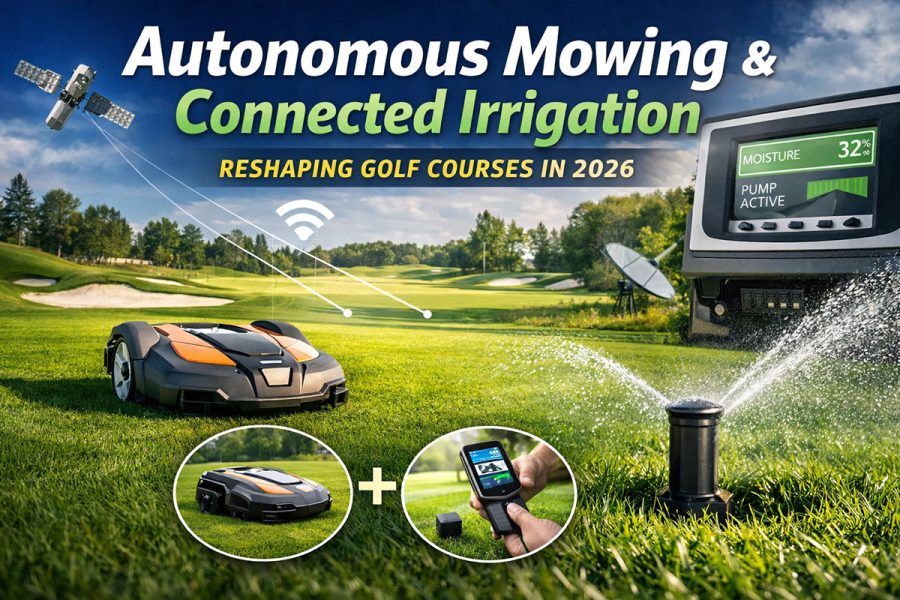
The biggest golf course technology story of 2026 is not just about clubs, carts, or range entertainment. It is about maintenance. Based on the momentum coming out of the 2026 PGA Show in Orlando, the 2026 GCSAA Conference and Trade Show, and the broader buying activity seen at Germany’s 2026 Hanse Golf and Rheingolf fairs, two categories are standing out for golf course operators: autonomous mowing and connected irrigation. The PGA Show framed 2026 as a major innovation year, with nearly 100 market-ready products in its New Product Zone and 1,195 participating brands overall, while GCSAA’s Orlando event put course-maintenance technology directly in front of superintendents and decision-makers.
For golf courses, this matters because the pressure is real. Teams are being asked to maintain strong playing conditions, operate efficiently, use water responsibly, and do more with the staff they already have. GCSAA’s latest national water survey found that U.S. golf courses used 31% less water in 2024 than in 2005, and it also reported increased use of handheld moisture sensors, ET data, irrigation audits, updated nozzles, software, and master controllers. In other words, the industry is already moving toward more precise, data-driven maintenance, and 2026 products are accelerating that shift.
Why autonomous mowing is getting serious attention
Autonomous mowing has moved beyond “interesting concept” status. At the 2026 GCSAA Conference and Trade Show, Husqvarna’s facility tour at Four Seasons Golf and Sports Club in Orlando gave attendees a real-world look at robotic mowing in action. According to GCM, the facility uses a dozen autonomous mowers across the resort and golf course, covering a combined 18.5 acres and saving about 20 labor hours per week. That is the kind of practical result golf course managers pay attention to.
The appeal is easy to understand. Autonomous mowers can handle repetitive mowing tasks so skilled staff can focus on detail work, equipment maintenance, bunker care, irrigation oversight, and golfer-facing priorities. Husqvarna positions its golf-course robotic lineup around low noise, no direct emissions, remote fleet management, and applications across tees, fairways, approaches, and roughs. Its CEORA platform is designed for large-area coverage, while the Automower 580L EPOS and 535 AWD EPOS target more specialized conditions, including steep or complex terrain.
That matters for local golf courses because labor flexibility is now a competitive advantage. Courses are not simply looking to replace people. They are trying to free up time. Even at the GCSAA demonstration, Husqvarna’s message was that robotics are about helping teams do more with the staff they have, not cutting headcount. That framing is important because it matches what most owners, superintendents, and operators actually need in 2026: consistency, reliability, and better use of limited labor hours.
Connected irrigation is becoming a command center
If autonomous mowing is about labor efficiency, connected irrigation is about decision-making. One of the most meaningful 2026 developments came from Rain Bird Golf, which announced new CirrusPRO integrations with Spectrum Technologies and Watertronics. Those additions allow golf courses to view FieldScout TDR350 soil-moisture data and live pump flow and pressure data inside the same software environment. That gives superintendents a more complete picture of what is happening across the property before they make irrigation decisions.
This is a bigger shift than it may sound at first. Traditional irrigation systems often depend on separate tools, separate screens, and separate decisions. Connected irrigation brings those pieces together. Rain Bird says the new integrations are meant to give superintendents greater flexibility in how they monitor course conditions and make irrigation decisions. The practical benefit is simple: better visibility can support better timing, better hand-watering choices, and more precise responses across greens, tees, and fairways.
That direction also lines up with what GCSAA education emphasized in Orlando. Coverage from the conference showed that water conservation sessions focused on gathering better data, using soil-moisture sensors, improving irrigation scheduling, and building more efficient, precise strategies. USGA and industry experts speaking at the event encouraged superintendents to analyze real course data before making watering decisions. In 2026, connected irrigation is increasingly becoming the toolset that makes that approach easier to execute every day.
Why these two technologies work so well together
Autonomous mowing and connected irrigation are powerful on their own, but together they point to the future of golf course maintenance. One system saves time on repetitive turf work. The other helps teams make smarter water decisions with better data. When both are used well, courses can create a more repeatable maintenance routine without sacrificing course conditions.
That combination also supports the larger themes showing up across 2026 industry events: efficiency, sustainability, and operational control. The PGA Show’s 2026 messaging centered on innovation and the future of the golf business, while Germany’s Hanse Golf and Rheingolf fairs highlighted a strong buying audience, exhibitor variety, and a noticeable sustainability angle in event positioning. Rheingolf in particular emphasized green electricity, district heating, public-transport access, and reusable materials. That does not mean every course is buying robots tomorrow, but it does show that the market is increasingly receptive to technology that improves operations while supporting environmental goals.
What golf courses should do next
Golf course owners and managers do not need to overhaul everything at once. A smarter approach is to start by identifying the biggest pain point.
If labor is the issue, look first at autonomous mowing opportunities in roughs, surrounds, approaches, or other repeatable areas where robotic systems can create immediate time savings. If water use and irrigation efficiency are the bigger challenge, start by evaluating whether your current setup can integrate moisture data, pump data, weather inputs, and scheduling tools into one connected system.
It is also worth thinking beyond maintenance alone. These technologies can support your broader brand. Courses that invest in efficient, modern operations are in a better position to market themselves as forward-thinking, sustainable, and committed to better playing conditions. That message can help with memberships, outings, daily-fee traffic, and even sponsorship conversations. In a competitive market, the story behind the course matters almost as much as the condition of the course itself.
Final thoughts
The newest products making the biggest impact on golf courses in 2026 are not only the ones golfers can see. Autonomous mowing and connected irrigation are changing how courses operate behind the scenes. The Orlando shows made that clear, and the broader European fair market supports the same direction: golf facilities want smarter tools, stronger efficiency, and better control over labor and water.
For golf courses that want to stay competitive, this is not technology to ignore. It is technology to start planning for now.