
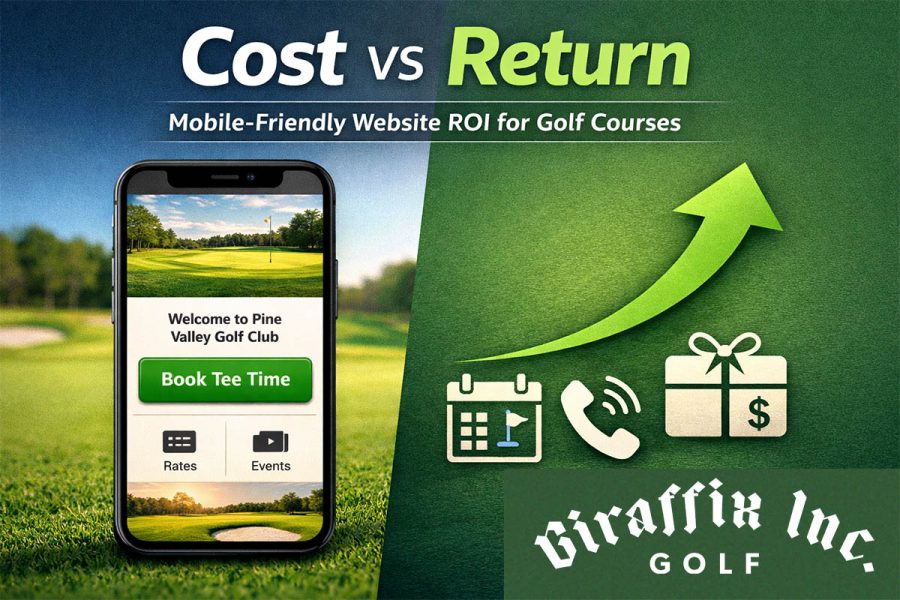
Golf courses don’t lose customers because their greens aren’t perfect—they lose customers because the digital experience is frustrating. And today, that experience starts (and usually ends) on a phone.
If your website loads slowly, forces people to pinch-and-zoom, hides key info, or makes booking a tee time feel like a scavenger hunt, you’re not just “due for an update.” You’re actively leaking revenue—often without realizing it.
Let’s break down what a new mobile-friendly website actually costs and what the return can look like for a golf course.
What “Mobile-Friendly” Really Means (And Why It Matters)
A mobile-friendly golf course website isn’t just a smaller version of your desktop site. It’s designed so a golfer can do the important stuff fast:
- Book a tee time in seconds
- See rates and specials without hunting
- Get directions with one tap
- Find course conditions, events, and leagues quickly
- Call the pro shop instantly
- Buy merch or gift cards easily
- Join an email list for deals and updates
That’s the difference between a website that exists and a website that performs.
The Real Costs of a New Mobile-Friendly Website
Website pricing can be all over the map, but here’s how most golf course builds shake out:
1) Basic Refresh (low investment)
Typical cost: $1,500–$4,000
Usually includes: new theme, basic mobile responsiveness, updated pages
Best for: very small courses that just need modern layout + clean info
Downside: tends to miss conversions—booking flow, SEO structure, speed, and branding polish.
2) Professional Mobile-First Website (high ROI zone)
Typical cost: $5,000–$15,000
Usually includes:
- Mobile-first design (built for phone users first)
- Speed optimization
- SEO-friendly structure
- Clear CTAs (book, call, directions, join league)
- Better photography/video integration
- Event pages and promo landing pages
- Conversion tracking
Best for: most public and semi-private courses serious about bookings and revenue.
3) Full Revenue Platform (website + ecommerce + automation)
Typical cost: $15,000–$35,000+
Usually includes:
- Ecommerce pro shop / gift cards / memberships
- Email + SMS automation
- Advanced analytics
- Custom integrations
- Member portals or league systems
- Landing pages for ads + campaigns
Best for: courses investing in year-round revenue and marketing.
The Cost You’re Already Paying (Even With an “Okay” Site)
Here’s the part most courses overlook: keeping an outdated website isn’t free. The “cost” shows up as missed opportunities:
- Fewer tee time conversions (especially from social + Google traffic)
- More calls to the pro shop for basic info (staff time)
- Lower trust from out-of-town golfers
- Less event revenue because details are unclear or buried
- Reduced repeat play because you don’t capture contact info
- Poor visibility on Google because of weak structure and slow speed
A website can be the best salesperson you have—or the biggest bottleneck.
Where the Return Comes From
A modern mobile-friendly website drives ROI in a few predictable ways:
1) More tee time bookings (and fewer abandoned sessions)
Most golfers are booking from a phone. If the booking button is obvious, the site is fast, and the path is simple, conversion rates go up.
Even a small improvement can be meaningful:
- If your site helps capture just 3–5 extra tee times per week
- At an average of $45–$70 per round
- That’s $7,000–$18,000 per year in direct lift (not counting cart fees, food, and shop spend)
2) Higher revenue per golfer
A good website makes it easy to promote:
- twilight specials
- league sign-ups
- events and tournaments
- memberships and punch cards
- gift cards (especially around holidays)
The goal isn’t just traffic—it’s getting golfers to take action.
3) Lower “pro shop support” load
When your website answers the top questions clearly (rates, hours, policies, leagues, direction, course status), your staff stops playing call center.
Less time on the phone = more time selling, checking in golfers, and running the experience.
4) Better performance from advertising and social media
If you run Facebook/Instagram ads, Google Ads, or boosted posts, sending clicks to a slow or confusing website wastes budget.
A mobile-first landing page can drastically improve:
- cost per lead
- booking conversions
- email signups
- event registrations
5) Stronger SEO (free traffic that keeps compounding)
Google favors sites that are fast, mobile-friendly, and well-structured. When your pages are built properly (services, events, tournaments, league pages, location signals), you start showing up more often for searches like:
- “golf course near me”
- “tee times in [city]”
- “golf leagues [city]”
- “golf simulator / winter golf [region]” (if applicable)
- “host a golf tournament [city]”
SEO is the long game—and a better site is the foundation.
A Simple ROI Example (Realistic, Not Hype)
Let’s say a new mobile-friendly website costs $9,500.
If it generates:
- 4 additional tee times/week
- average 2.5 golfers per tee time
- average spend $55 per golfer (greens + cart blend)
That’s:
- 4 tee times x 2.5 golfers = 10 golfers/week
- 10 golfers x $55 = $550/week
- $550 x 30 active weeks = $16,500/year
That’s a payback period of well under a year—and that’s before pro shop sales, food/bev, leagues, tournaments, and gift cards.
The Best Way to Think About Website Investment
A golf course website isn’t a brochure. It’s a revenue tool.
If your site does these three things well, you usually win:
- Makes booking and calling effortless
- Builds trust instantly with clean design + strong visuals
- Turns visitors into repeat golfers through promotions and email capture
What Giraffix Golf Builds (Mobile-First, Revenue-First)
At Giraffix Golf, we design websites for golf courses with one goal: measurable return.
That means:
- fast-loading mobile-first pages
- clear “Book Tee Time” and “Call Pro Shop” actions
- SEO structure that helps you show up locally
- event + league pages built to convert
- photo/video integration that makes the course look like it feels in person
- tracking so you can see what’s working
Ready to See What Your Website Is Actually Worth?
If you’re unsure whether a new site would pay off, we can assess your current website and identify:
- where golfers are dropping off
- what pages are underperforming
- how to improve bookings and leads quickly
- what upgrades will deliver the biggest return first
A mobile-friendly website isn’t about looking modern—it’s about capturing revenue you’re already earning, but currently losing online.
1) How much does a mobile-friendly golf course website cost?
Costs typically range from a basic refresh to a full mobile-first build with SEO and conversion tools. The best ROI usually comes from a professional mobile-first site built for bookings and calls.
2) How does a new website increase tee time bookings?
A mobile-first layout makes the “Book Tee Time” path faster and clearer, reduces load time, and removes friction—so fewer golfers abandon the process.
3) Will a new website help my golf course show up on Google?
Yes. Faster load times, better structure, local SEO signals, and clean page architecture can improve visibility for searches like “golf course near me” and “tee times in [city].”
4) What pages matter most for ROI?
For most courses: Tee Times, Rates, Memberships, Leagues, Tournaments/Events, Course Conditions, and Contact/Directions drive the most action and revenue.
5) What’s the quickest way to see if our current website is costing us money?
Check mobile speed, how many clicks it takes to book, whether rates are easy to find, and if key CTAs (book/call/directions) are immediately visible on a phone.